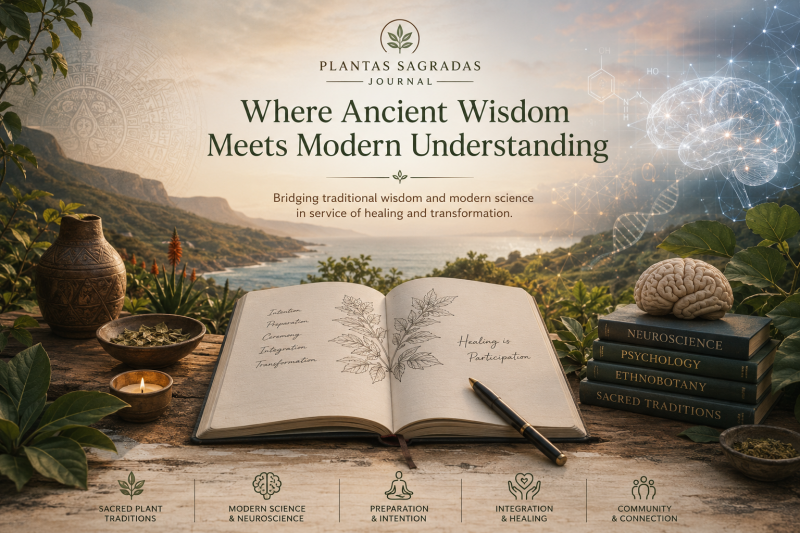
Where Ancient Wisdom Meets Modern Understanding
Healing is one of humanity's oldest pursuits, yet our understanding of it continues to evolve. Across cultures and generations, people have turned to nature, community, introspection, and ceremony in search of relief from suffering and a deeper connection to themselves. Today, modern science is beginning to explore many of these same traditions through the lens of neuroscience, psychology, and medicine.
The Plantas Sagradas Journal was created to help bridge these worlds.
Our mission is to provide thoughtful, evidence-informed articles that explore sacred plant traditions, psychology, neuroscience, preparation, integration, and the lifelong process of healing. We believe meaningful education should neither exaggerate nor diminish the potential of these medicines. Instead, it should encourage curiosity, critical thinking, humility, and respect.
Throughout this Journal, you'll find articles written for individuals who are simply curious, those considering a retreat, healthcare professionals seeking a deeper understanding, and anyone interested in the intersection of traditional wisdom and modern science. Whether we are discussing ibogaine, psilocybin, ayahuasca, kambo, trauma, addiction, or emotional healing, our goal remains the same: to provide balanced, compassionate, and responsible information that empowers individuals to make informed decisions.
At Plantas Sagradas, we believe healing is not something that happens to us. It is something we actively participate in. Sacred medicines may illuminate the path, but lasting transformation emerges through preparation, intention, integration, and the choices we make long after the ceremony has ended.
This Journal reflects that philosophy. Each article is an invitation to explore, to question, and to continue learning. We hope these writings support your journey with knowledge, perspective, and a deeper appreciation for the complexity and beauty of human healing.
Welcome to The Plantas Sagradas Journal.
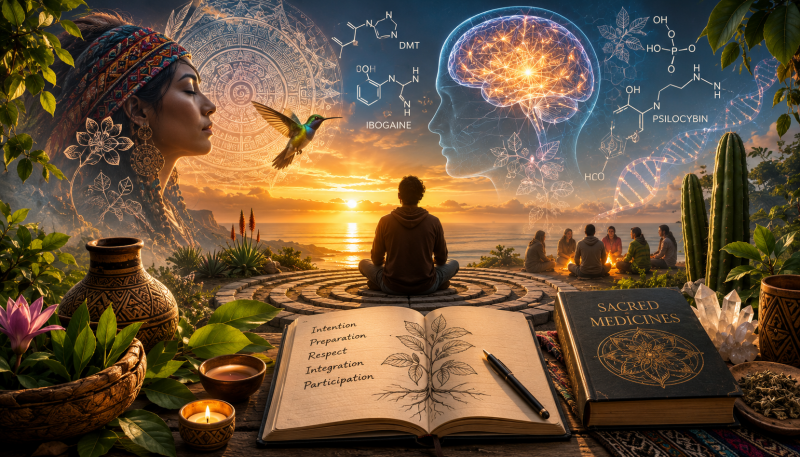
What Are Sacred Medicines?
Understanding Their Role in Healing, Growth, and Human Consciousness
For as long as human beings have existed, we have searched for ways to alleviate suffering and better understand ourselves. Across continents and throughout history, every culture has developed practices intended to restore balance during times of illness, emotional pain, grief, uncertainty, or spiritual crisis. Some traditions turned to prayer, meditation, fasting, or movement. Others gathered in ceremony around plants and naturally occurring medicines that were believed to deepen awareness, strengthen community, and reconnect individuals with something larger than themselves.
Long before psychology became a profession or neuroscience emerged as a field of study, Indigenous cultures had already developed sophisticated systems of healing rooted in observation, relationship, ritual, and nature. These traditions continue today, carried forward by communities who have safeguarded this knowledge through generations.
In recent decades, many of these same medicines have attracted growing interest within medicine, psychology, and neuroscience. Researchers are exploring how certain plant medicines may influence brain networks involved in learning, emotional processing, memory, and cognitive flexibility. While much remains to be understood, the convergence of ancient traditions and modern science has created an opportunity to ask an important question:
What exactly are sacred medicines, and why have they remained part of human healing traditions for thousands of years?
More Than Chemicals
One of the first things I often tell people is that sacred medicines are far more than the compounds they contain.
From a scientific perspective, we can describe ibogaine, psilocybin, mescaline, and DMT by their molecular structures, receptor binding profiles, pharmacokinetics, and neurobiological effects. These are important areas of study that continue to expand our understanding of how these substances interact with the human brain.
Yet reducing these medicines solely to chemistry risks overlooking something equally important.
For the cultures that have worked with them for generations, these medicines have never existed in isolation. They are inseparable from ceremony, intention, community, music, storytelling, preparation, and relationship. They are embedded within entire systems of meaning that shape how the experience unfolds and how its lessons are integrated afterward.
Modern science and traditional wisdom do not have to compete with one another. I believe they each illuminate different aspects of the same reality.
My Own Journey
People often ask how I became interested in this work.
The answer is deeply personal.
I did not begin exploring sacred medicines out of curiosity alone. Like many people who eventually find this path, I arrived carrying years of unresolved suffering. My own history included addiction, trauma, emotional numbness, and an ongoing search to understand why certain patterns continued repeating despite years of personal effort and professional training.
My first experience with ibogaine profoundly challenged the way I understood healing. It wasn't because the medicine "fixed" me overnight. It didn't.
What it offered was something far more valuable.
It created an opportunity to see myself differently.
It allowed me to observe patterns I had lived inside for years without fully recognizing them. It revealed connections between my thoughts, emotions, behaviors, relationships, and history that had previously existed outside my awareness.
That experience became the beginning of a much longer journey rather than its conclusion.
Over the seven years that followed, I immersed myself in studying psychology, neuroscience, systems theory, trauma, attachment, Indigenous healing traditions, and psychedelic-assisted psychotherapy. Those years eventually became the foundation for Functional Systems Regulation Theory (FSRT), the framework I developed to better understand how human beings organize themselves around adaptation, suffering, and healing.
Today, I view sacred medicines not as miraculous cures but as catalysts that may temporarily expand our capacity to perceive ourselves with greater honesty, compassion, and openness. What we choose to do with that expanded awareness ultimately determines whether meaningful transformation occurs.
What Makes a Medicine "Sacred"?
The word sacred does not refer to a specific religion.
Instead, it reflects the attitude with which these medicines have traditionally been approached.
Across many Indigenous traditions, these medicines are treated with humility and respect because they have the capacity to evoke deeply meaningful psychological, emotional, and spiritual experiences. They are often received within carefully structured ceremonies guided by experienced practitioners who understand both the medicine and the community in which it is used.
Calling them sacred is less about assigning mystical qualities and more about recognizing that experiences capable of profoundly affecting a person's life deserve care, preparation, and responsibility.
Ancient Wisdom Meets Modern Science
One of the most exciting developments of the past two decades is that science is beginning to investigate questions that Indigenous communities have explored for generations.
Researchers are studying how certain psychedelic compounds may temporarily alter communication between large-scale brain networks, promote neuroplasticity, facilitate emotional learning, and increase psychological flexibility. These areas of research may eventually deepen our understanding of conditions such as depression, trauma, addiction, and anxiety.
At the same time, science also reminds us of something equally important.
These medicines are not appropriate for everyone.
They carry real medical, psychological, and legal considerations that require careful screening and professional oversight. Respecting these realities is not a limitation of these medicines. It is part of honoring them responsibly.
Every Medicine Has Its Own Character
One of the most common misconceptions is that all sacred medicines produce similar experiences.
They do not.
Ibogaine, ayahuasca, psilocybin, San Pedro, peyote, and kambo each originate from different cultures, possess unique histories, and interact with the human body in very different ways. Their traditional purposes, physiological effects, duration, risks, and psychological characteristics vary considerably.
Over the coming months, this Journal will explore each of these medicines individually, examining both their traditional contexts and the emerging scientific literature that seeks to better understand them.
Healing Is Not Something That Happens to Us
If there is one lesson my own journey has taught me, it is this:
Healing is not an event.
It is a relationship.
No ceremony, therapist, medicine, or breakthrough experience can permanently reorganize a life on its own.
Real healing emerges through participation.
It is reflected in the conversations we have after ceremony. The boundaries we learn to establish. The relationships we choose to repair. The difficult truths we become willing to face. The habits we gradually reshape. The compassion we begin extending toward ourselves. The countless ordinary decisions that slowly transform extraordinary experiences into enduring change.
Sacred medicines may illuminate the path.
Walking it remains our responsibility.
Why We Created This Journal
When Adrian and I founded Plantas Sagradas, we wanted to create more than a retreat center. We wanted to create a place where education, preparation, safety, and integration would receive the same level of attention as the ceremonies themselves.
This Journal is an extension of that commitment.
Some articles will explore neuroscience. Others will discuss Indigenous traditions, psychology, trauma, addiction, integration, preparation, ethics, and the evolving scientific literature surrounding sacred medicines. Throughout every article, our goal will remain the same: to offer balanced, thoughtful, and compassionate information that helps individuals make informed decisions while honoring both traditional wisdom and modern understanding.
Whether you are simply curious, considering your first retreat, supporting someone you love, or working as a healthcare professional, I hope these writings offer not only information but perspective.
Because in the end, healing has never belonged exclusively to science or spirituality.
It belongs to humanity.
And perhaps the future of healing will not be found by choosing one over the other, but by allowing each to deepen our understanding of the other.