For many people, the ceremony is what captures their attention.
It is the experience they have read about, watched documentaries about, or heard described by friends. Whether someone is considering ibogaine, ayahuasca, psilocybin, or another sacred medicine, it is natural to wonder what the experience itself will be like. Questions about visions, emotions, insights, and transformation often become the center of attention.
Yet after years of working with individuals before and after sacred medicine experiences, I have come to believe something that may initially sound surprising.
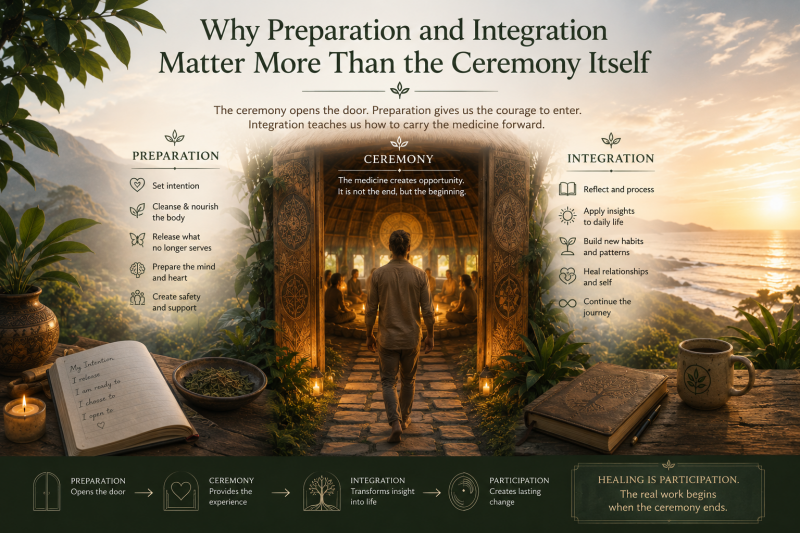
The ceremony is not the most important part of the journey.
In many ways, it is simply the beginning.
The experiences that unfold during ceremony can be profound, beautiful, confusing, emotionally overwhelming, or unexpectedly quiet. Some people encounter vivid imagery. Others experience powerful emotional release. Some gain immediate clarity, while others leave with more questions than answers.
None of these outcomes, by themselves, determine whether meaningful healing will occur.
What ultimately shapes long-term transformation is what happens before the ceremony and what happens after it.
Healing Begins Before the Medicine
One of the most common misconceptions surrounding sacred medicines is that healing begins the moment the medicine is administered.
In reality, I believe preparation is the first ceremony.
The days and weeks leading up to a retreat begin organizing the mind and body for the experience to come. Preparation is not simply about avoiding certain foods or temporarily stopping medications under appropriate medical supervision. Those practical steps certainly matter, but preparation extends much deeper.
It involves slowing down enough to honestly examine why you are seeking this experience.
What patterns continue repeating in your life?
What relationships need attention?
What emotions have become difficult to feel?
What are you hoping will change?
These questions do not always have immediate answers, nor should they. Their purpose is not to solve your problems before arriving. Rather, they begin cultivating the openness, humility, and curiosity that allow meaningful work to unfold.
Preparation also creates safety.
At Plantas Sagradas, we devote significant attention to comprehensive medical screening, psychological assessment, medication review, and individualized planning. While these measures may seem less exciting than the ceremony itself, they represent one of the most important expressions of respect for both the medicine and the individual.
Safety is never separate from healing.
It creates the conditions in which healing becomes possible.
The Ceremony Creates Opportunity
Sacred medicines have an extraordinary capacity to temporarily shift perception.
For a period of time, familiar ways of thinking, feeling, and relating may soften enough for new perspectives to emerge. Individuals often describe seeing longstanding patterns with greater clarity, reconnecting with forgotten memories, experiencing profound emotional release, or feeling a renewed sense of connection with themselves and others.
These moments can feel life changing.
Sometimes they are.
But insight alone rarely changes a life.
One of the greatest lessons my own journey has taught me is that awareness and transformation are not the same thing.
Seeing a pattern is very different from reorganizing it.
Understanding why a relationship has remained unhealthy does not automatically teach us how to create healthier ones.
Recognizing unresolved grief does not instantly complete the grieving process.
The ceremony may reveal what needs attention.
Living differently afterward is where healing begins taking root.
Why Integration Is Where Change Happens
The word integration has become increasingly common within discussions of psychedelic-assisted healing, but its meaning is often reduced to a few conversations after ceremony.
I see integration as something much larger.
Integration is the ongoing process of translating extraordinary experiences into ordinary life.
It is where insight becomes behavior.
Where emotional breakthroughs become healthier relationships.
Where forgiveness becomes action.
Where values become daily habits.
Where healing gradually becomes visible not because of what happened during ceremony, but because of how someone begins living afterward.
For some people, integration may involve therapy.
For others, it may include journaling, meditation, exercise, creative expression, community, or difficult conversations that have been postponed for years.
There is no universal formula.
What matters is the willingness to continue participating in the work after the intensity of the experience has passed.
Transformation Is Measured in Ordinary Moments
Many people expect healing to arrive as a dramatic breakthrough.
Sometimes it does.
More often, however, transformation quietly reveals itself through ordinary moments.
You respond differently during an argument.
You establish a boundary that once felt impossible.
You become more patient with your children.
You notice anxiety arising without immediately reacting to it.
You begin sleeping better.
You reconnect with friends.
You apologize.
You forgive.
You laugh more easily.
None of these moments make headlines.
Yet together they represent something far more meaningful than a powerful ceremony remembered years later.
They represent a life that is gradually becoming organized in a healthier way.
Healing Is Participation
As I continued studying psychology, trauma, systems theory, and my own experiences with sacred medicines, one realization became increasingly clear.
Healing is not something that happens to us.
It is something we participate in.
Sacred medicines may temporarily expand awareness, soften rigid patterns, or create conditions that make change possible.
They cannot make our decisions for us.
They cannot practice healthier communication.
They cannot repair relationships.
They cannot establish routines, exercise for us, or help us consistently choose behaviors that align with the life we hope to build.
Those responsibilities remain ours.
This understanding eventually became one of the foundational principles of Functional Systems Regulation Theory, the framework I developed while trying to understand why some individuals experience lasting transformation after profound experiences while others gradually return to familiar patterns.
Insight creates possibility.
Participation creates change.
Why Plantas Sagradas Places So Much Emphasis on Preparation and Integration
When Adrian and I envisioned Plantas Sagradas, we knew we did not want to build a retreat centered solely around ceremonies.
We wanted to create an environment that honored the entire journey.
That means helping individuals prepare thoughtfully before they arrive.
Conducting careful medical and psychological screening.
Creating safe and supportive ceremonial environments.
Providing time for reflection rather than rushing from one experience to the next.
Offering opportunities for integration throughout the retreat.
And encouraging continued support after participants return home.
For us, the retreat is not the destination.
It is one chapter within a much larger process of healing.
The Ceremony Ends. The Journey Continues.
Every ceremony eventually comes to an end.
The songs become quiet.
The medicine gradually leaves the body.
The sun rises.
People return home.
The real question is no longer what happened during the ceremony.
The real question becomes:
Who are you becoming because of it?
That answer unfolds not over a single night, but through weeks, months, and years of intentional living.
Sacred medicines may open the door.
Preparation gives us the courage to walk through it.
Integration teaches us how to continue walking long after the ceremony has ended.
At Plantas Sagradas, we believe that is where lasting healing lives.
To learn more about the Plantas Sagradas philosophy follow the link below to explore Functional Systems Regulation Theory (FSRT).
Add comment
Comments